For a short biography of my radio life, click here.
Location. Pegram, TN - approximately 20 miles due west of Nashville (a.k.a. Music City) Tennessee.
K4RO is on a sharp ridge which peaks about 800' above mean sea level. The 97 foot high tower
base is at about 750' AMSL. The horizon is viewable for almost 360
degrees from the tower top. There is roughly a 50' rise to the NNE.
The location is a rocky and heavily wooded ridgetop. Soil conductivity is
rather poor in the immediate area, with rich fertile plains 250-300' below in
the Harpeth Valley. My real estate is approximately one acre of land.
The majority of my land is heavily wooded and steeply sloped.
160 Meters. My Top Band antenna is a one-quarter wavelength (127 foot long) sloping vertical wire. The wire is hung from the tower at 90 feet on an insulated PVC side mount. There is a single 1/4 wavelength elevated radial strung among the tree trunks as high as I could get it with a small step ladder. The vertical radiator is about 45 degrees from true vertical. It was good enough for a QSO with FT5ZM operating from Amsterdam Island (11,570 miles away) on 160 meters. Ridge top and mountain top locations are a radio man's dream. It's hard to beat geography when it comes to radiation angles.
Low Band Receive Antennas. In February 1999 I started experimenting with Beverage antennas for receiving. I now have three Beverage antennas. One is 550 feet long and is bi-directional. It runs NE/SW. The second is about 165' long and runs WNW/ESE. It is also bi-directional. The third is about 500' long and points NNE. The antennas allow a total of five directions. Any Beverage can be fed to either radio by means of a multicoupler relay box designed by K9AY.
The NNE feed point is over 400' from the shack, and about 180' lower in elevation. It is a very quiet receiving antenna, and it can also be used as an auxillary "distant" antenna for simultaneous TX/RX on the same band. Due to the shorter lengths of these antennas, they tend to perform better on 40m and 80m than they do on 160m. The bottom line is that on some nights, the Beverages make all the difference in the world.
All Beverage antennas are fed with surplus 75-ohm RG-6 coaxial cable, which was obtained for free when the cable TV company re-cabled the neighborhood in mid 1990's. It was important to scan the coax with a time domain reflectometer (TDR) to find any existing faults. Two thousand feet of RG-6 was obtained for free using this method. Much of the coax has been replaced, as coax does not last forever. Adding the Beverage low band receive antennas was one of the most cost-effective improvements that I've made to my station, as well as my contest scores. Thank you Harold Beverage for the pioneering research which still holds strong to this day, over a century later.
80 Meters. On eighty meters I am using a quarter wave sloper antenna ("half sloper") with the feedpoint at 80' and sloping North. I got lucky with the half sloper on 80m. It works very well in domestic contests, and seems to hold its own in 80m DX pileups as well. My secondary antenna for 80m is a quarter wave ground mounted inverted-L. The first 32 feet are aluminum, and the second 32 feet is #12 solid copper insulated wire. Currently there are about 32 radials and counting.
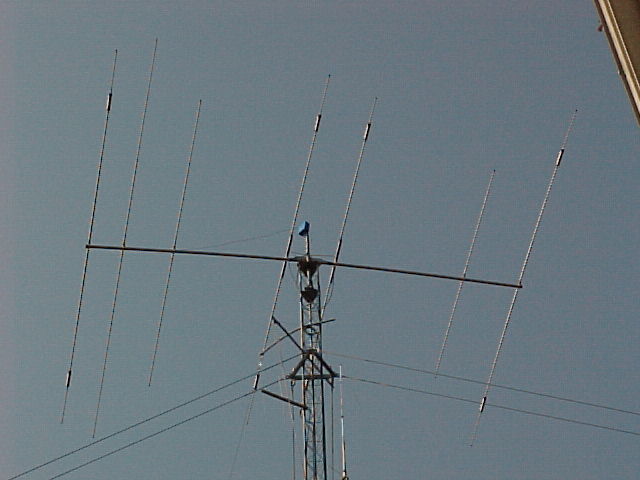
40 Meters. I have two primary antennas for 40 meters. One is the boom of the top Mosley PRO-57A 5-bander antenna. The design is from N4KG, and utilizes an omega match to provide a direct 50 ohm feed. I am using two large air variable transmitting capacitors mounted in an outdoor-rated electrical junction box. A piece of #4 copper is used as a gamma wire for the omega match. I attached the wire about 8 feet out from the boom center before putting the antenna on the tower. The antenna is actually a shortened dipole (24' boom) with the outer-most elements acting as capacity hats. The shortened dipole is theoretically down a dB or so from a full size dipole in terms of efficiency. However, it is also at 97 feet and it is in the clear. It works far better than any wire diople or loop antenna that I've tried. Construction was very inexpensive, requiring only a feedline and the matching network. I re-built the omega match in October 1999. To see photos and details of the omega match, click here.
I also have an Off-Center Fed dipole at about 60' above ground. It is 22 feet on one side and 11 feet on the other side, and fed with coax directly to a DX Engineering high power 4:1 balun at the feed point. The OCF dipole is used extensively with the second radio on 20 and 10 meters. The OCF dipole does not work on 15 meters at all, so I have an auxiliary dipole for that band as the second radio 15 meter antenna.
In May 2003, I installed a two-element full-size 40 meter Inverted-V yagi fixed on Europe. This simple wire beam is currently my best antenna for Europe and Northern Africa on 40 meters. Over the years, periodic tweaks in dimensions and geometry have resulted in a fairly effective antenna. If I had enough tower for a real 40 meter yagi, I'd have put one up long ago. Beginning contesters beware! Put up as much tower as you can to start with. You won't regret the decision.
20 Meters. For the high bands, I have a stack of Mosley PRO-57A antennas. The antennas cover 20-17-15-12-10 meters. There are 7 elements on a 24' boom, mounted at 60 and 97 feet on Rohn 25 tower. There are three active elements on each band, except for 12 meters, which is two active elements. I opted to not try the larger PRO series antennas with 30m and 40m elements. Instead, I am using the boom loading method for 40m described above. The yagis are fed using a WX0B stack match. The top antenna is turned with a Hy-Gain Tailtwister, and the lower with a TIC TR-1 Ring Rotator. The lower antenna and ring rotator were added in July 1998. After numerous problems with various TIC control boxes, I tried a Green Heron rotator controller, and all of the problems went away.
17, 15, 12, and 10 Meters. See above.
Tower. K4RO is a one-tower contest station, with a single 97-foot high Rohn 25G tower. The tower is guyed at 30' 60' and 90', with double guys (6) at 90' to a triangular anti-torsion triangle bracket at the top. All guys were replaced with 6700 lb EHS equivalent Phillystran in October 1997, except for the bottom 23' or so of each guy wire, which is 1/4" EHS.
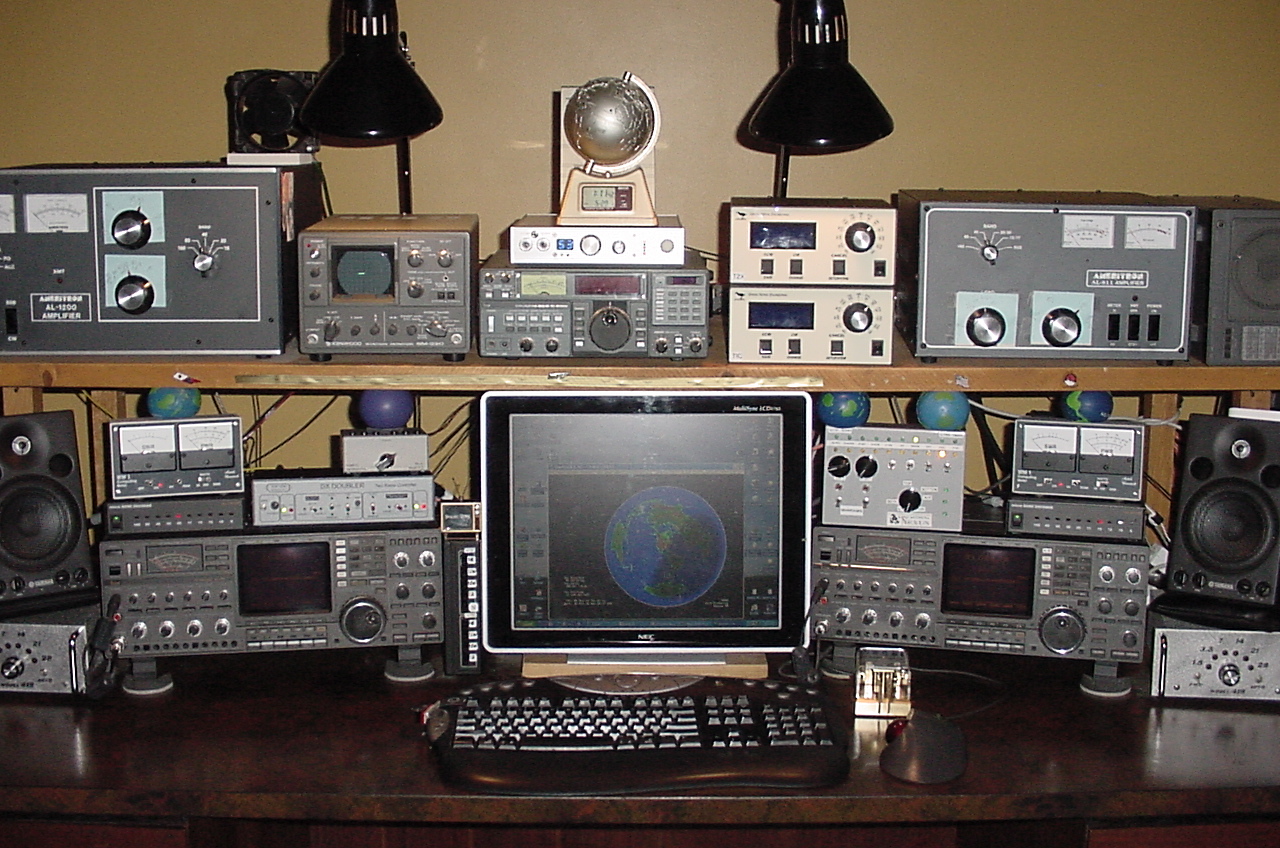
Radios & amps. Like most of the K4RO station, the radios and amplifiers were all purchased as used equipment. I run a pair of Icom transceivers, with one radio's receiver in each ear. Current transceivers are IC-7700. I like the ergonomics and sound of the radio. Most contest operations are SO2R (single-op-two-radio.) I also have a fifty year old Collins receiver that I use mostly for copying the mail. Ameritron and Alpha amplifiers complete the setup.
Switching, filters, etc. All antennas are resonant (with the low bands tweaked for CW.) Antennas are automatically switched via band decoders and automatic antenna relays. The system receives band information via the serial frequency data from the transceivers. Any unused antenna is instantly available to either radio. I also have the ability to take the lower yagi out of the stack configuration, and use it separately on either radio. A custom home brew control panel is used to select default and alternate antennas for each radio and band.
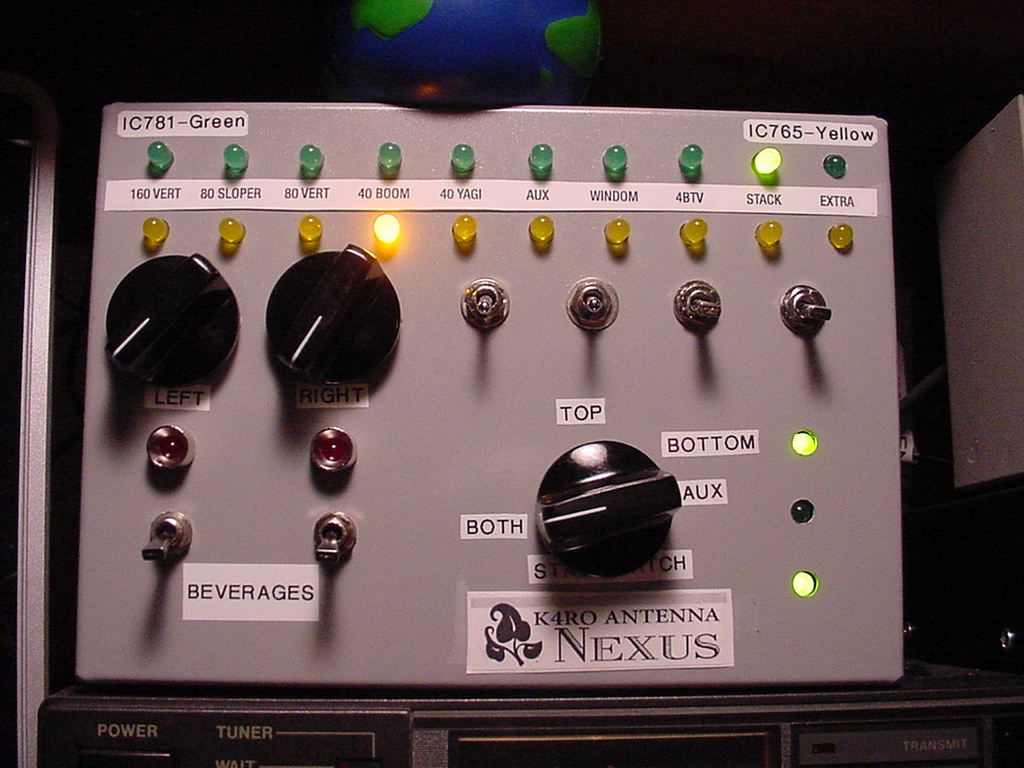
The stack is fed with 1/2" 50 ohm heliax, which was bought used. Bandpass filters are used on each rig for SO2R (Single Op 2 Radio) contesting. The bandpass filters are also automatically bandswitched. The station is fully automatic. I can choose any band on either radio and immediately start working stations. Any unused antenna is immediately available to either radio.
Miscellaneous. After many years as a die hard TR-Log fan, I finally retired the DOS computer. I now use N1MM Logger+ for real-time logging during contests. After the contest, I import my logs into Logger32, which I use for all non-contest operating, QSLing, and awards tracking. At Dayton 2001 I obtained a "DX Doubler" Two Radio Controller from Top Ten Devices. The DXD replaced the rats-nest of cables and switches which made up my old home-brew SO2R (Single Operator 2 Radio) lash-up. Over two decades later, I am still using it for every contest. I enjoy making incremental station improvements as my enthusiasm, time, and budget allow. Have a look inside the shack.
If you have any questions or comments, you may email me at the following address:

Visit the Tennessee Contest Group Home Page .